English
 中文简体
中文简体
Content
- 1 What Non-Standard Stamping Parts Are and When You Need Them
- 2 Material Selection: Steel, Aluminum, Brass, and Stainless Steel Compared
- 3 The Production Process: From Client Drawing to Finished Component
- 4 Complex Geometries and Specialized Features in Non-Standard Stamping
- 5 Industry Applications and Material-Application Matching
- 6 Evaluating a Supplier's Capability for Non-Standard Stamping Production
What Non-Standard Stamping Parts Are and When You Need Them
NON-STANDARD STAMPING PARTS are precision metal components produced through stamping processes — using dies and punches to press metal sheets into specific shapes — where the geometry, dimensions, and functional features are custom-engineered to meet requirements that no catalog or off-the-shelf product can satisfy. The distinction from standard stamping parts is not merely a matter of size variation. Non-standard parts involve entirely custom die design, application-specific material selection, and engineering validation processes tailored to a unique assembly or performance requirement defined by the client rather than by an industry standard or supplier catalog specification.
The practical need for non-standard stamping parts arises in any engineering situation where a product's design cannot be compromised to fit available standard components without sacrificing performance, weight targets, assembly efficiency, or dimensional integrity. A standard bracket may be close in size to what an automotive assembly requires, but if the mounting hole pattern, material thickness, or flange geometry differs by even a fraction of a millimeter from the design requirement, the standard part introduces stress concentrations, assembly misalignment, or warranty risk that no amount of secondary machining can reliably eliminate. Non-standard stamping resolves this by producing the exact component the design demands — to the drawing, not to the nearest catalog equivalent.
Industries where off-the-shelf solutions are regularly inadequate include automotive, aerospace, electronics, and industrial machinery — sectors where assembly tolerances, regulatory compliance requirements, and system-level performance targets are too precise to accommodate the dimensional compromises inherent in standard parts. Understanding how non-standard stamping parts are engineered, what materials best serve which applications, and how to evaluate a supplier's capability to produce them reliably is the foundation of effective custom component sourcing.
Material Selection: Steel, Aluminum, Brass, and Stainless Steel Compared
The choice of metal for non-standard stamping parts directly determines the component's mechanical performance, corrosion behavior, weight, stampability, and cost — five variables that must be balanced simultaneously against the specific demands of the target application. The four primary materials used in non-standard stamping — steel, aluminum, brass, and stainless steel — each offer a distinct combination of these properties, making material selection one of the most consequential engineering decisions in the custom stamping process.
Steel: Strength, Formability, and Cost Efficiency
Steel is the most widely specified material for non-standard stamping parts across automotive, machinery, and structural applications. Cold-rolled steel grades — SPCC, DC01, and their higher-strength variants such as high-strength low-alloy (HSLA) steels — offer an exceptional combination of tensile strength (ranging from 270 MPa for mild cold-rolled grades to over 780 MPa for advanced high-strength steels), excellent deep-drawing formability, and the lowest material cost per kilogram of any engineering metal. Galvanized and electrogalvanized steel variants add corrosion protection for parts exposed to humidity, road salt, or outdoor environments without the cost premium of stainless alloys. For structural brackets, chassis reinforcements, enclosure panels, and mechanical linkage components where strength-to-cost ratio is the primary design driver, steel remains the default material selection in non-standard stamping engineering.
Aluminum: Lightweight Performance for Weight-Critical Applications
Aluminum alloys — particularly 1050, 3003, 5052, and 6061 grades in sheet form — are specified for non-standard stamping parts where weight reduction is a primary engineering objective. Aluminum's density of 2.7 g/cm³, compared with 7.85 g/cm³ for steel, enables component weight reductions of 50 to 60% at equivalent volume, a critical advantage in aerospace structural components, electric vehicle battery enclosure stampings, and consumer electronics chassis parts where every gram of mass reduction has downstream value in fuel efficiency, battery range, or portability. Aluminum stampings also benefit from the metal's natural oxide layer, which provides adequate corrosion resistance for most interior applications without additional surface treatment, reducing per-part finishing cost relative to steel alternatives that require plating or coating for equivalent corrosion performance.
Brass: Conductivity, Machinability, and Aesthetic Appeal
Brass — copper-zinc alloys in grades such as C26000 (cartridge brass, 70% Cu / 30% Zn) and C28000 (Muntz metal, 60% Cu / 40% Zn) — occupies a specialized but important niche in non-standard stamping parts production. Its electrical conductivity, approximately 28% of copper's conductivity, makes it the preferred material for stamped electrical terminals, connector housings, relay contact springs, and grounding clips in electronics and telecommunications equipment where both conductivity and stampability in thin gauges are required. Brass's excellent machinability also simplifies secondary operations — threading, drilling, and milling — that non-standard parts frequently require after stamping. In plumbing fittings, decorative hardware, and instrumentation components, brass's warm gold appearance and resistance to dezincification in water service environments make it the functional and aesthetic material of choice.
The Production Process: From Client Drawing to Finished Component
The production workflow for non-standard stamping parts follows a structured sequence that differs significantly from standard parts manufacturing because every tooling element must be designed and fabricated from scratch for each new component. Understanding this sequence helps procurement engineers set realistic project timelines, identify the milestones where design changes are still cost-effective, and evaluate supplier capability at each production stage.
- Design review and DFM analysis: The client provides detailed specifications and drawings — typically 2D engineering drawings with GD&T callouts and 3D CAD models in STEP or IGES format. The stamping supplier's engineering team conducts a Design for Manufacturability (DFM) analysis, identifying features that may cause die wear, springback issues, or forming cracks, and proposing geometry modifications that maintain functional intent while improving stampability and tooling life.
- Die design and tooling fabrication: Custom dies and tooling are designed using CAD/CAM software and fabricated from tool steel (D2, SKD11, or equivalent hardened grades) using CNC machining, EDM wire cutting, and surface grinding. Progressive die tooling — where multiple stamping operations are performed in sequence on a single press stroke — reduces per-part cycle time and improves dimensional consistency for complex non-standard parts with multiple features.
- First article inspection and tooling validation: Initial production samples are measured against the drawing using coordinate measuring machines (CMM), optical comparators, and functional gauges. Dimensional deviations are used to guide die adjustment — shimming, polishing, or relief grinding — until all critical dimensions fall within the specified tolerance window before production approval is granted.
- Production stamping and in-process inspection: Metal sheets are fed into stamping presses — mechanical, hydraulic, or servo-driven depending on the force and precision requirements — where they are shaped according to the unique design at production speeds typically ranging from 20 to 400 strokes per minute. Statistical process control (SPC) with regular dimensional sampling maintains quality through the production run.
- Secondary operations and surface treatment: Non-standard parts frequently require deburring, tapping, welding, bending to secondary angles, or surface finishing — zinc plating, nickel plating, anodizing for aluminum, or powder coating — applied after primary stamping to meet the complete component specification.
Complex Geometries and Specialized Features in Non-Standard Stamping
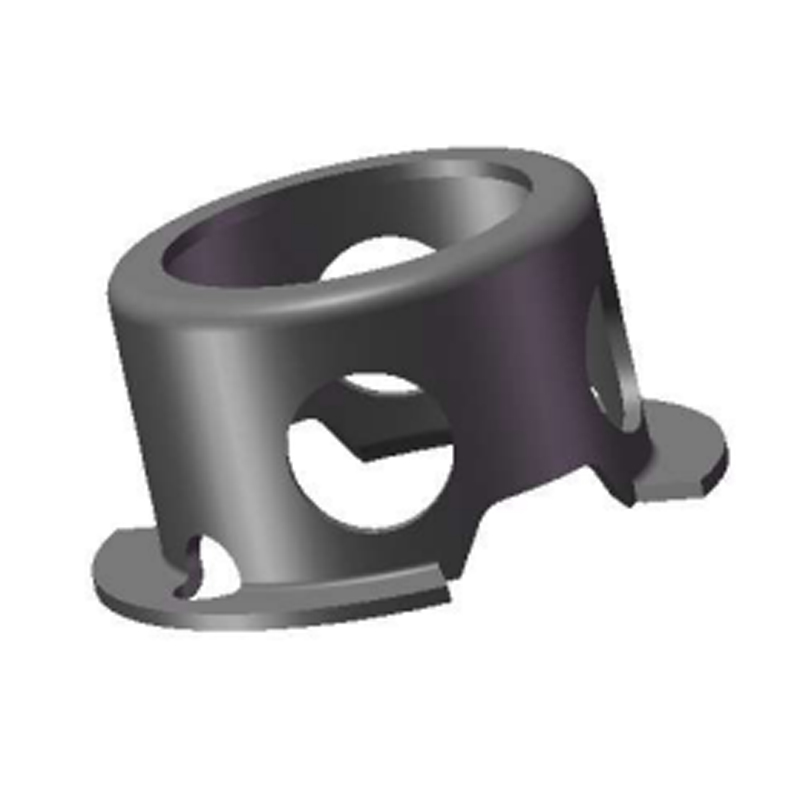
The defining characteristic of non-standard stamping parts is their geometric complexity relative to standard catalog components. Where a standard bracket has a simple L or U profile with a fixed hole pattern, non-standard parts may incorporate features that require multiple forming stages, specialized die mechanisms, or secondary operations to produce accurately and consistently.
Complex geometries in non-standard stamping parts include deep-drawn cups and channels where the draw depth exceeds the part diameter, requiring carefully controlled blank holder pressure and lubrication to prevent wrinkling or tearing; compound-angle bends where flanges must form at non-orthogonal angles relative to the part datum; and embossed or coined features — localized areas where the metal is compressed under high pressure to produce precise thickness reductions, raised lettering, or surface patterns that serve functional or identification purposes.
Specialized features integrated into non-standard stamping parts during the stamping process itself — rather than added in secondary machining operations — include reinforced sections where additional material thickness is maintained in high-stress zones by controlling metal flow during drawing; integrated mounting points such as extruded holes (pierced and flanged in a single die operation) that provide threaded engagement length without welded nuts; and precision cutouts with sharp internal corners achieved through fine blanking rather than conventional punching, producing shear faces with less than 10% rollover and no die break that eliminates the need for secondary deburring in close-tolerance assembly interfaces.
Industry Applications and Material-Application Matching
The versatility of non-standard stamping parts across industry sectors is best understood through the specific application requirements that drive material and geometry choices in each sector. The following table summarizes representative applications across the primary industries served by custom stamping, with the material and feature combinations typically specified:
| Industry | Typical Non-Standard Part | Primary Material | Key Feature Requirements |
|---|---|---|---|
| Automotive | Body reinforcement brackets, seat frame stamping | HSLA Steel | High strength, tight tolerances, crash performance |
| Aerospace | Structural clips, avionics enclosure panels | Aluminum 5052 / 6061 | Weight minimization, corrosion resistance, AS9100 traceability |
| Electronics | Connector terminals, EMI shielding cans | Brass / Stainless Steel | Conductivity, fine blanking precision, thin gauge forming |
| Industrial Machinery | Custom mounting plates, cam and lever stampings | Steel (DC01, S235) | Dimensional accuracy, fatigue resistance, surface hardness |
| Medical Devices | Instrument housings, surgical tool components | Stainless Steel 316L | Biocompatibility, sterilization resistance, burr-free edges |
Evaluating a Supplier's Capability for Non-Standard Stamping Production
Selecting a supplier for non-standard stamping parts requires evaluating technical infrastructure, engineering capability, quality systems, and production capacity in a way that is fundamentally different from sourcing standard catalog components. Because every non-standard part begins with custom tooling that represents a significant upfront investment — typically ranging from a few thousand dollars for simple single-operation dies to tens of thousands for complex progressive tooling — the supplier's ability to design, fabricate, and validate that tooling correctly on the first iteration has direct financial and schedule consequences for the buyer.
- In-house die design and toolroom capability: Suppliers with CNC machining, EDM wire cutting, and surface grinding equipment in-house can respond to tooling modifications and die repairs faster and at lower cost than those relying on external toolmakers, reducing the time between design change requests and qualified first articles.
- Press capacity range and tonnage coverage: A supplier operating presses from 25 to 400 tons can accommodate non-standard parts across a wide range of material thicknesses and blank sizes without outsourcing operations that exceed their equipment envelope, maintaining quality control throughout the full production process.
- Material handling and traceability systems: For aerospace, automotive, and medical non-standard stamping parts, material certification traceability from mill certificate to finished part is a mandatory quality requirement. Suppliers with documented material receiving inspection procedures and batch-level production records support this requirement without requiring buyers to implement supplementary controls.
- Metrology and inspection infrastructure: CMM capability, optical comparators, and calibrated go/no-go gauge sets for critical features are minimum requirements for non-standard stamping suppliers serving precision industries. First article inspection reports (FAIR) and capability studies (Cpk analysis) for critical dimensions are standard deliverables that should be contractually specified before tooling investment is authorized.
- Relevant industry certifications: ISO 9001:2015 as the baseline quality management system; IATF 16949 for automotive supply chain participation; AS9100 for aerospace; ISO 13485 for medical device component manufacturing. These certifications confirm that the supplier's quality management processes are independently audited and systematically maintained — a prerequisite for non-standard stamping parts in regulated industries where component traceability and process validation are compliance requirements.