English
 中文简体
中文简体
Content
- 1 What Are Snap Rings and Why Do They Matter
- 2 Types of Snap Rings: Internal vs. External
- 3 Industry Standards: DIN 471, DIN 472, and GB 894
- 4 What Are Snap Ring Pliers and How Do You Choose the Right One
- 5 Step-by-Step: Installing and Removing Snap Rings
- 6 Snap Rings Across Industries
- 7 Choosing a Reliable Snap Ring Manufacturer
What Are Snap Rings and Why Do They Matter
A snap ring — also called a retaining ring, circlip, or C-clip — is a small but load-bearing fastener that fits into a machined groove on a shaft or inside a bore. Once installed, it acts as a mechanical stop, preventing bearings, gears, spacers, and other components from moving axially out of position.
Despite their compact size, snap rings carry serious responsibility. In a transmission assembly, a misplaced or failed snap ring can allow a gear to migrate, throwing the entire drivetrain out of alignment. In a hydraulic cylinder, a loose circlip can result in catastrophic seal failure. For engineers and maintenance teams, understanding snap ring selection is not optional — it is foundational to reliable machine design.
The snap ring's core advantage over alternative retention methods is simplicity. No threading. No adhesive. No welding. A properly installed snap ring snaps into its groove in seconds and stays there under significant axial load — making it one of the most efficient fasteners in mechanical engineering.
Types of Snap Rings: Internal vs. External
Every snap ring selection starts with one question: is the ring going into a bore (internal) or onto a shaft (external)? These two configurations are not interchangeable, and the pliers used to install them work in opposite directions.
External Snap Rings
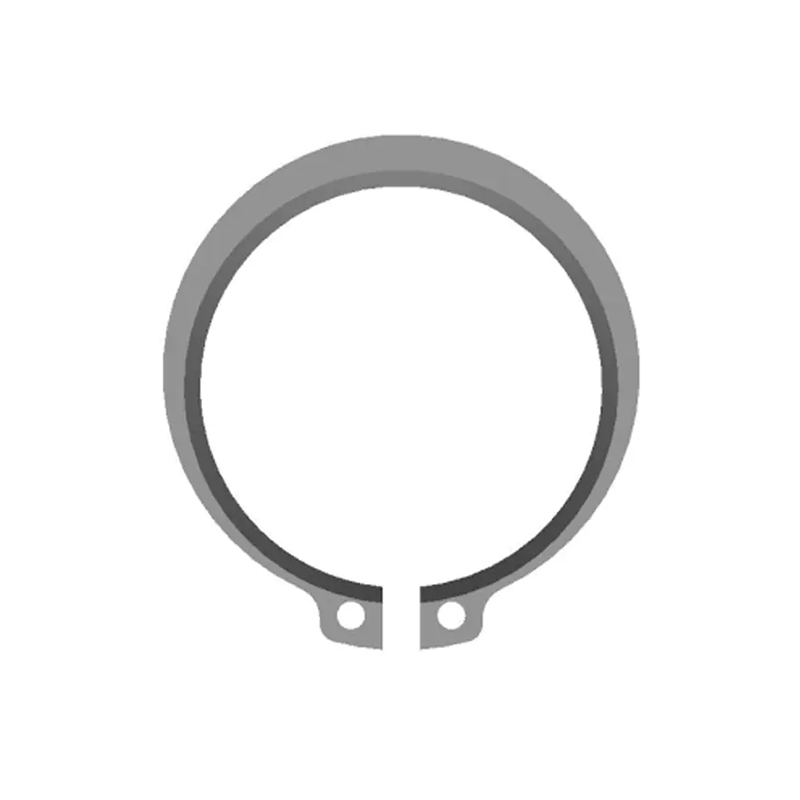
External snap rings — standardized as DIN 471 for metric shafts — fit into a groove cut around the outside of a shaft. They are compressed to install: the pliers squeeze the ring's ends together, reducing its diameter enough to pass over the shaft, then the ring springs outward into the groove. External rings are the dominant choice in automotive driveshafts, gearboxes, axle assemblies, and electric motor shafts.
Internal Snap Rings
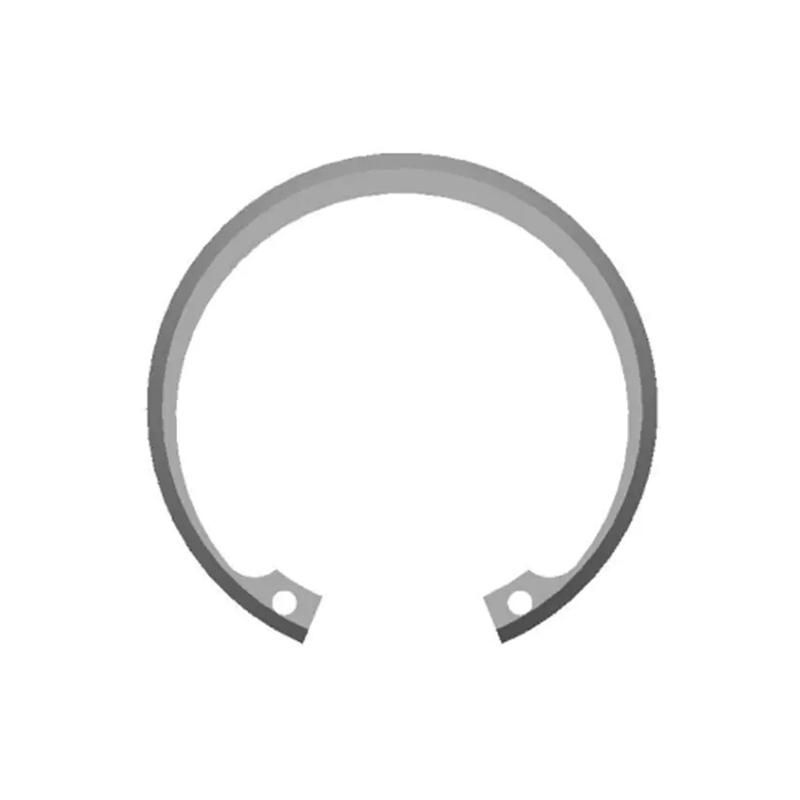
Internal snap rings — standardized as DIN 472 — fit inside a groove machined into a bore or housing. Here the installation logic reverses: the pliers expand the ring so it can be inserted into the bore, then release to let it contract and seat in the groove. Internal rings are widely used in hydraulic cylinders, motor housings, bearing bores, and wheel hubs.
Beyond the C-Type: Other Common Configurations
While C-type (tapered section) snap rings dominate general machinery, several other configurations address specific needs. E-rings (DIN 6799) clip onto a shaft groove from the side without requiring pliers, making them useful in tight lateral spaces. Constant-section snap rings offer a uniform cross-section, distributing stress more evenly and handling higher or more dynamic axial loads. Spiral retaining rings, wound from flat wire, provide 360-degree groove contact and are favored in high-load or vibration-prone environments where a standard C-type might rock or seat unevenly.
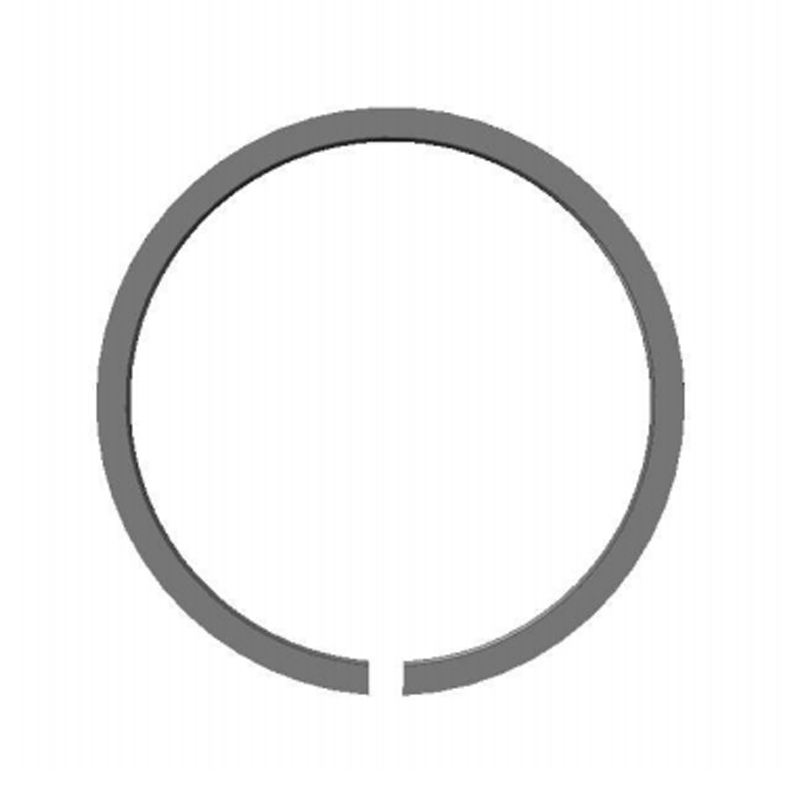
For most standard shaft and bore applications, Dongbo offers a comprehensive range of precision-engineered snap rings for shafts and bores, as well as dedicated internal circlips for bore applications across metric and custom sizes.
Material Options
The baseline material for snap rings is carbon spring steel (SAE 1060–1090 equivalent, or the premium C67S grade favored in European and automotive standards) — high strength, good fatigue resistance, and cost-effective for most industrial environments. For corrosive, food-grade, or marine applications, stainless steel (typically 301 or 1.4122) provides the necessary oxidation resistance. Specialty alloys including beryllium copper and PH17-7 stainless are specified for high-temperature or non-magnetic applications in aerospace and defense.
Industry Standards: DIN 471, DIN 472, and GB 894
Snap rings are not one-size-fits-all. Their groove dimensions, thickness tolerances, and load ratings are governed by specific standards — and specifying the correct standard is what ensures interchangeability, reliability, and traceability across your supply chain.
DIN 471 (external retaining rings for shafts) and DIN 472 (internal retaining rings for bores) are the global benchmarks, originating from the German Institute for Standardization. Even as ISO standards have expanded, DIN 471 and DIN 472 remain the reference point for metric snap ring procurement worldwide, particularly across European OEMs and their global supply chains.
In China, GB 894-2017 governs elastic retaining rings and aligns closely with DIN dimensions for the most common sizes, ensuring compatibility in domestically manufactured assemblies. For buyers sourcing from Chinese manufacturers, confirming which standard the supplier follows — and verifying that groove tolerances match the ring specification — is a critical due-diligence step.
Dongbo manufactures external circlips manufactured to DIN 471 and has participated in the formulation and revision of 13 national standards related to elastic retaining rings, giving Dongbo's products full dimensional traceability against both DIN and GB specifications.
When reviewing a snap ring datasheet, pay attention to three tolerance-sensitive parameters: groove width, groove depth, and groove diameter. A groove that is too narrow will over-compress the ring, reducing its spring-back and retention force. A groove that is too shallow risks the ring popping out under axial load. Matching ring and groove specifications precisely is not a detail — it is the entire mechanism.
What Are Snap Ring Pliers and How Do You Choose the Right One
Snap ring pliers are the dedicated tool for installing and removing snap rings. Using a screwdriver or general-purpose pliers is a common shortcut that risks damaging the ring, the groove, or nearby components — and can send a ring flying at high speed, a genuine safety hazard. The right pliers make installation controlled, repeatable, and safe.
Internal vs. External Pliers
The first selection criterion mirrors the ring type. External snap ring pliers have tips that point outward: squeezing the handles compresses the ring for installation on a shaft. Internal snap ring pliers work in reverse — squeezing the handles spreads the tips apart, expanding the ring for insertion into a bore. Using the wrong type will either fail to open the ring sufficiently or apply force in the wrong direction entirely.
Tip Angle: Straight, 45°, and 90°
Once you know internal or external, the next variable is tip angle, which determines access to the work area. Straight-tip pliers offer the clearest sight line and are the default for open assemblies with no obstructions. 45° angled tips are the workhorse for partially recessed grooves, giving the technician a better grip angle without requiring the pliers to be fully perpendicular to the shaft. 90° (right-angle) tips are reserved for deeply recessed grooves or confined spaces where the straight approach is geometrically impossible — common in automotive transaxle work and tight motor housings.
Tip Size and Precision
Snap ring lug holes come in specific diameters, and the plier tips must fit properly — too small and they'll slip, too large and they won't seat. Precision-machined tips, typically 0.070 in. (1.8 mm) or 0.090 in. (2.3 mm), ensure a clean engagement. For miniature snap rings — some as small as 0.5 mm in diameter — purpose-built micro snap ring pliers are available, and standard pliers simply will not control the ring accurately enough.
Interchangeable vs. Fixed-Tip Sets
For shops that encounter a variety of snap ring sizes and types, a set with interchangeable tip heads (straight, 45°, 90° for both internal and external use) offers the best coverage. Fixed-tip individual pliers are preferred for high-volume production environments where one technician runs one specific ring type all day and needs maximum tactile feedback without switching heads.
Step-by-Step: Installing and Removing Snap Rings
Snap rings are deceptively simple to install — until one goes wrong. Proper technique prevents ring damage, groove wear, and the risk of the ring becoming a projectile during installation.
Installation (External Snap Ring on a Shaft)
- Confirm the ring and groove match. Check ring diameter, groove width, and groove depth against the datasheet before picking up any tool.
- Select the correct pliers. External ring, so external pliers. Choose the tip angle based on access — straight if the groove is fully accessible, angled if it is recessed.
- Seat the tips securely in the lug holes. The tips must be fully engaged before applying any force. A partial engagement risks the ring slipping off the pliers at full compression.
- Compress only as far as necessary. Open the ring just enough to clear the shaft diameter. Over-expanding a snap ring beyond its elastic limit permanently deforms it — a deformed ring will not seat correctly and loses its retention force.
- Slide over the shaft and align with the groove. With the ring compressed, position it over the shaft end and move it along until it aligns with the groove.
- Release gradually and verify seating. Slowly release the plier handles. The ring should spring into the groove with an audible snap. Visually confirm that the ring sits flush and evenly around the entire groove circumference — an uneven fit signals a groove tolerance issue or ring damage.
Removal
Removal reverses the installation sequence. Re-seat the plier tips in the lug holes, apply only the compression or expansion needed to clear the groove, slide the ring off the shaft or out of the bore, and inspect both the ring and groove for wear before deciding whether to reuse or replace. For critical applications, replacing the snap ring after each removal is the conservative — and correct — choice.
Safety Note
Wear safety glasses during snap ring installation and removal. A ring that slips off the pliers under load can travel at significant velocity. This is especially true for large-diameter external rings, which store considerable elastic energy when compressed.
Snap Rings Across Industries
Few fastener types appear across as many industries as the snap ring. Its combination of small envelope, high axial load capacity, and tool-free disassembly makes it nearly universal.
Automotive
Snap rings secure bearings and gears in transmission systems, retain CV joint components in driveshafts, and hold suspension components on strut assemblies. Automotive applications are among the most demanding for snap rings: high rotational speeds, thermal cycling, vibration, and contamination are the operating environment, not the exception. Automotive-grade snap rings are typically manufactured to tighter dimensional tolerances and tested to higher load specifications than general industrial rings.
Industrial Machinery and Automation
In factory automation, snap rings retain rollers, pulleys, and encoder discs on motor shafts, and secure bearings inside motor housings. Their ease of removal makes them practical for equipment that requires regular maintenance and component replacement without full shaft disassembly.
Aerospace and Defense
Snap rings appear in aircraft landing gear mechanisms, turbine assemblies, and flight control linkages. In these applications, material certification, dimensional traceability, and fatigue performance under extreme temperature and load cycling are non-negotiable procurement requirements.
Agricultural and Construction Equipment
Heavy equipment — excavators, combine harvesters, loaders — relies on snap rings to retain gears and bearings in high-torque drive systems exposed to mud, water, and impact loads. The combination of robust constant-section or spiral ring types with appropriate surface treatment (phosphate-oiled or zinc-flake coating) is typical in these environments.
Energy
Wind turbine pitch and yaw bearings, hydraulic components in solar tracking systems, and valve assemblies in power generation all incorporate retaining rings where reliable axial retention across long service intervals is required.
Choosing a Reliable Snap Ring Manufacturer
A snap ring costs cents. Its failure costs exponentially more. The selection of a snap ring manufacturer deserves more scrutiny than the unit price alone suggests.
Material traceability is the first filter. The best manufacturers control their raw material from the strip steel stage, not just incoming inspection. Using a premium grade like C67S cold-rolled strip steel — controlled to within 0.03 mm thickness tolerance — eliminates the variability that arises when sourcing strip steel from the open market. Dongbo operates its own AGC cold-rolling production line, producing 18,000 tons of precision strip steel annually and eliminating reliance on external raw material suppliers.
Heat treatment certification is equally critical. Snap rings derive their spring characteristics from controlled heat treatment, and process variability at this stage directly affects fatigue life and retention force. Look for manufacturers certified to CQI-9 (Special Process: Heat Treat System Assessment), the automotive-driven standard that mandates online monitoring and permanent archiving of all heat treatment parameters. This is what makes the process traceable and auditable, not just claimed.
Standard compliance and test capability determine whether the finished product performs as specified. Manufacturers that hold IATF 16949 (automotive quality management), ISO 14001 (environmental management), and CNAS laboratory accreditation have demonstrated their quality system and testing capability to independent auditors — not just internal inspection.
Finally, supply depth matters for OEM sourcing. A manufacturer that covers both standard DIN/GB dimensions and custom non-standard geometries — across carbon steel, stainless steel, and specialty alloys — reduces the supplier count and simplifies incoming quality management.
Explore Dongbo's Dongbo's in-house manufacturing process and review our quality control standards and certifications to understand how each of these criteria is addressed across our full product range.