English
 中文简体
中文简体
Circlips, retaining rings, and snap rings are precision fasteners designed to secure components on shafts or inside bores without threading, welding, or additional hardware. Choosing the right type — internal, external, stamped, beveled, or a specific material grade such as 1.4122 stainless steel or 51CrV4 spring steel — directly affects load capacity, corrosion resistance, and service life. This article gives engineers, procurement specialists, and maintenance professionals a practical reference covering every major variant, material specification, and selection criterion.
Content
- 1 Internal vs. External Circlips: Core Differences
- 2 Stamping Circlips: Manufacturing Process and Design Implications
- 3 Beveled Retaining Rings: When Flat Rings Are Not Enough
- 4 Material Grades: 1.4122, 51CrV4, and 50CrV4 Explained
- 5 Material Selection Guide by Application
- 6 Relevant Standards and Specifications
- 7 Snap Ring Variants: E-Rings, Bowed Rings, and Spiral Rings
- 8 Groove Design: The Most Common Source of Circlip Failure
- 9 Installation Best Practices and Common Mistakes
- 10 Procurement Checklist: Specifying Circlips Without Ambiguity
Internal vs. External Circlips: Core Differences
The most fundamental distinction in the retaining ring family is the installation direction — whether the ring seats inside a housing bore or outside a shaft groove.
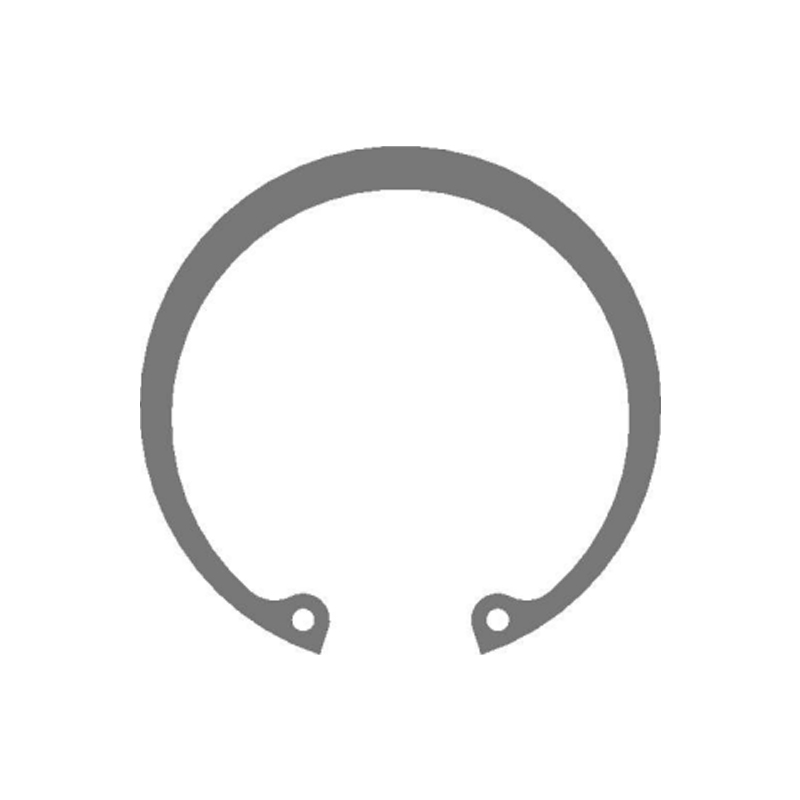
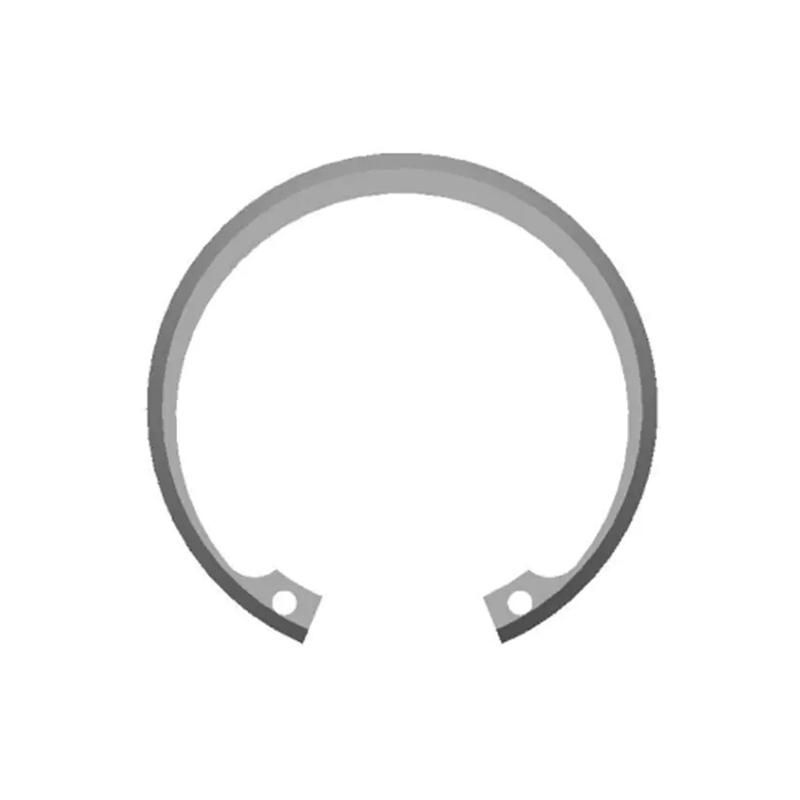
Internal Circlips
Internal circlips (also called internal retaining rings or internal snap rings) are installed into a machined groove inside a cylindrical bore. When seated, the ring's outer diameter bears against the groove walls, creating an axial stop for a shaft, bearing, or pin inserted through the bore. They are compressed during installation and expand to grip the groove once pliers are released.
Typical applications include bearing retention in gearboxes, wheel hubs, hydraulic cylinders, and electric motor end caps. Standard bore sizes range from 8 mm to 300 mm under DIN 472, with groove depth and width tolerances specified to H11/h11 for reliable seating.
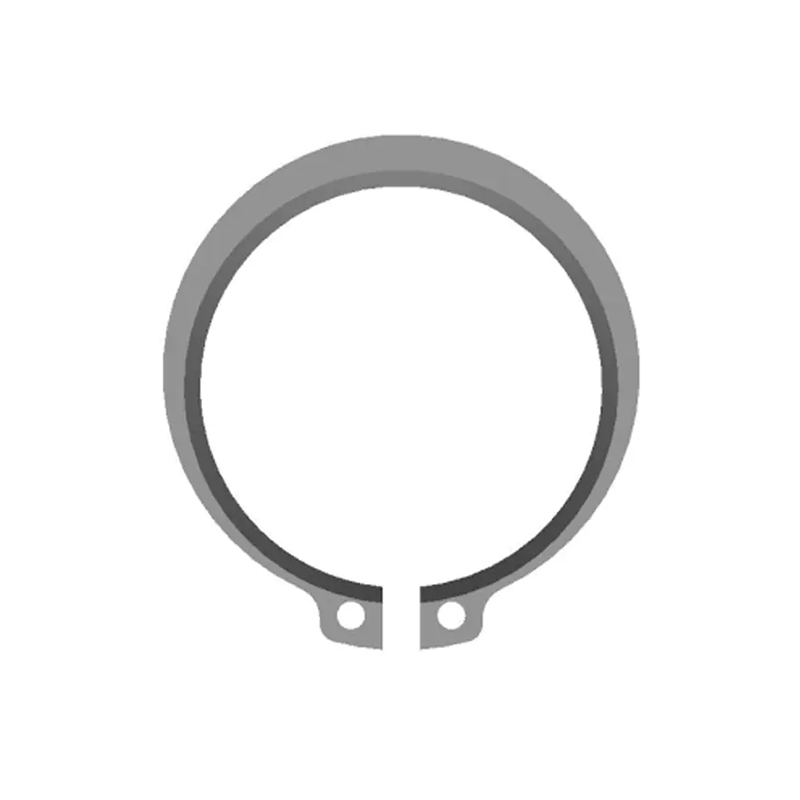
External Circlips
External circlips install into a groove on the outside of a shaft or pin. Their inner diameter bears against the groove, and the ring's open ends face outward. They are spread apart during installation using external circlip pliers. External circlips are the most commonly specified variant globally, covering shaft diameters from 3 mm to 300 mm per DIN 471.
Typical uses include retaining gears, pulleys, and sprockets on drive shafts; securing pistons in pneumatic cylinders; and locking axle components in automotive drivetrains. The DIN 471 standard specifies groove dimensions including groove diameter (d3), groove width (m), and groove depth (t) to ensure full ring engagement and predictable thrust load capacity.
Key Dimensional and Load Differences
| Property | Internal Circlip (DIN 472) | External Circlip (DIN 471) |
|---|---|---|
| Groove location | Inside bore | Outside shaft |
| Installation tool | Internal (compressing) pliers | External (spreading) pliers |
| Standard size range | 8–300 mm bore | 3–300 mm shaft |
| Ring opens during install | Compressed (diameter reduced) | Expanded (diameter increased) |
| Typical thrust load (d=20 mm, spring steel) | ~5.0–7.5 kN | ~3.5–5.5 kN |
As the table illustrates, internal circlips generally achieve higher thrust load ratings at equivalent sizes because the bore wall provides a larger bearing surface compared to a shaft groove. Engineers should always verify actual load capacity against manufacturer data sheets, as values vary by ring thickness, groove tolerance, and material.
Stamping Circlips: Manufacturing Process and Design Implications
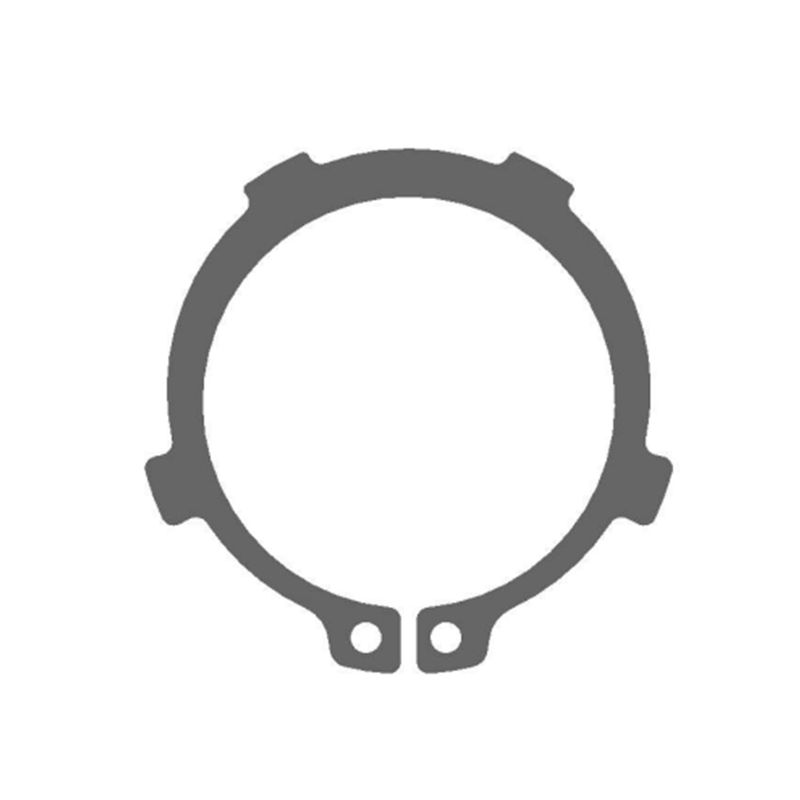
Stamping circlips are produced by die-cutting flat sheet or strip steel into the characteristic open-ring profile, as opposed to wire-formed or machined variants. This manufacturing method defines several important performance and cost characteristics.
In the stamping process, a progressive die punches the ring profile from cold-rolled strip steel in a single or multi-stage press operation. The edges are then deburred, and the rings are heat-treated (hardened and tempered) to achieve the spring properties required for elastic installation and reliable groove engagement. Phosphate coating, zinc plating, or passivation is applied as a final surface treatment.
Key advantages of stamping circlips include:
- Low unit cost at volume — stamping is highly automated, enabling production of millions of identical rings per day with minimal labor content
- Consistent thickness — derived directly from strip steel gauge, typically ±0.05 mm tolerance, which is critical for predictable groove fit
- High repeatability — die-stamped profiles hold tighter dimensional consistency than hand-formed alternatives
- Wide material compatibility — spring steel, stainless steel, and non-ferrous alloys can all be processed through stamping
The primary limitation of stamped circlips is that the flat profile concentrates stress at the lug holes during installation. If over-spread or over-compressed beyond the manufacturer's maximum allowable gap, the ring may crack at the lug. For applications requiring repeated installation and removal (serviceability > 5 cycles), using a ring with generous lug geometry and confirmed material elongation > 8% is advisable.
Beveled Retaining Rings: When Flat Rings Are Not Enough
A beveled retaining ring (also called a bevel-edge snap ring or Smalley-type ring) features a cross-section where the contact faces are angled rather than flat. This bevel — typically 15° on both contact faces — creates a wedging action when axial load is applied.
The wedging geometry delivers three specific engineering advantages:
- Elimination of axial play: As load increases, the beveled ring is forced deeper into its groove, taking up any end-play between ring and retained component. This is critical in precision bearing preload applications where zero axial clearance is required.
- Higher effective thrust capacity: The wedge effect distributes load more evenly across the groove walls, typically increasing thrust capacity by 30–60% compared to flat rings of identical thickness and diameter.
- Vibration resistance: Because the ring self-tightens under load, it resists loosening under dynamic or oscillating axial forces — a common failure mode for flat rings in high-vibration environments such as compressors, pumps, and vehicle drivetrains.
The groove for beveled retaining rings must be machined to a matching bevel angle. Standard groove dimensions for beveled rings are defined in DIN 983 (external) and DIN 984 (internal). Mixing a beveled ring with a flat-bottom groove eliminates the wedging benefit and can cause accelerated groove wear.
Material Grades: 1.4122, 51CrV4, and 50CrV4 Explained
Material selection is one of the most consequential decisions in circlip specification. The three dominant material families — carbon spring steel, chromium-vanadium spring steel, and martensitic stainless steel — each suit specific operating environments.
1.4122 Stainless Steel Circlips
Material 1.4122 is a martensitic stainless steel (equivalent to X39CrMo17-1) containing approximately 16–18% chromium and 0.9–1.1% molybdenum. It is the industry-standard grade for stainless steel circlips and retaining rings across European markets.
After hardening and tempering, 1.4122 circlips achieve a tensile strength of 1,100–1,300 MPa and a hardness of 36–46 HRC — sufficient spring properties for reliable groove engagement while maintaining corrosion resistance superior to carbon steel grades. The molybdenum addition enhances resistance to pitting and crevice corrosion compared to standard 1.4021 (X20Cr13) stainless.
1.4122 circlips are specified for:
- Food processing and pharmaceutical equipment where corrosion contamination is unacceptable
- Marine and offshore applications with salt spray exposure (salt spray life > 200 hours per ISO 9227)
- Chemical processing environments with mild acid or alkali exposure
- Medical and surgical instruments requiring autoclave sterilization compatibility
One important limitation: 1.4122 stainless has approximately 15–20% lower thrust load capacity than equivalent-sized 51CrV4 spring steel rings due to lower yield strength. Engineers specifying stainless circlips for high-load applications should upsize ring thickness or verify load margins carefully.
51CrV4 and 50CrV4 Spring Steel
51CrV4 (material number 1.8159) and 50CrV4 (1.8158) are closely related chromium-vanadium alloy spring steels. The designations refer to nominal carbon content — 0.47–0.55% C for 51CrV4, and 0.46–0.54% C for 50CrV4 — with both containing 0.90–1.20% chromium and 0.10–0.20% vanadium.
These grades are functionally interchangeable in most circlip applications. Both are heat-treated to achieve:
- Tensile strength: 1,250–1,600 MPa
- Hardness: 42–52 HRC
- Elongation at break: 8–12%, providing the ductility needed to withstand elastic deformation during installation without fracture
The vanadium addition refines the grain structure and improves fatigue resistance compared to plain carbon steel grades like C75 or C85. This makes 51CrV4 and 50CrV4 the preferred choice for dynamic loading applications — automotive transmissions, agricultural machinery, conveyor drives — where the retaining ring is subjected to repeated cyclic loads rather than a static axial stop.
Both grades require surface protection for outdoor or humid environments. Standard finishes include:
- Phosphate + oil (Fe3PO4): baseline corrosion protection, 24–48 hours neutral salt spray
- Zinc electro-plating (6–12 µm): 72–240 hours salt spray, most common for automotive OEM
- Dacromet / geomet: chromium-free coating achieving 480–720 hours salt spray, increasingly specified for EU REACH compliance
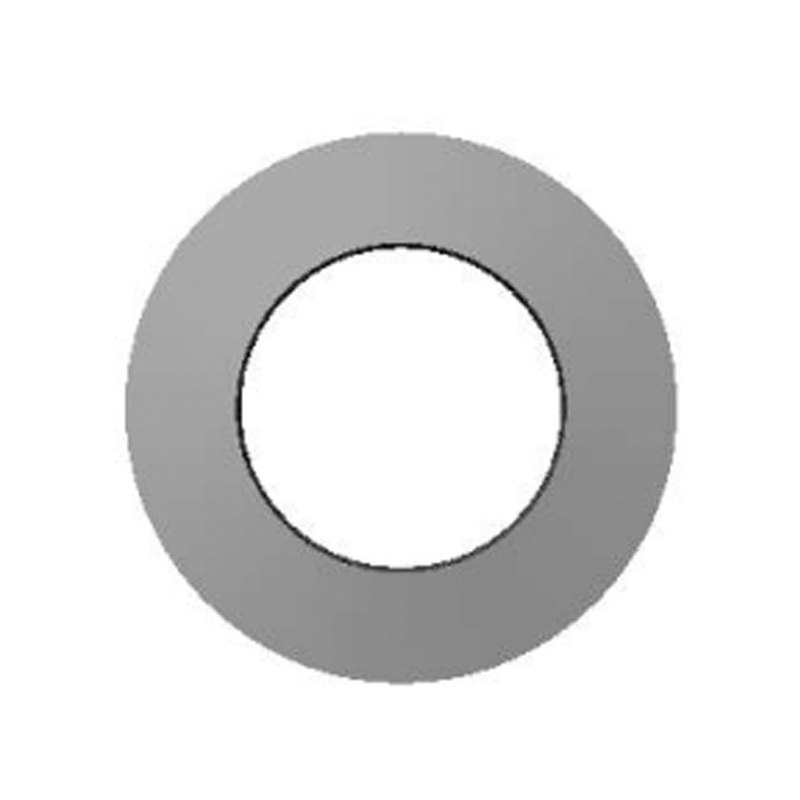
51CrV4 Washers and 50CrV4 Washers
Beyond circlips, 51CrV4 and 50CrV4 strip steel is widely used to produce spring washers, wave washers, and Belleville (disc spring) washers. In assemblies where a circlip is used alongside a spring washer to eliminate end-play while compensating for thermal expansion, specifying both components in the same alloy grade ensures consistent spring rate behavior across the operating temperature range (typically –40°C to +120°C for standard heat treatment).
Material Selection Guide by Application
The following table consolidates material choice recommendations across the most common circlip and retaining ring applications:
| Application Environment | Recommended Material | Key Reason | Surface Finish |
|---|---|---|---|
| Automotive drivetrain (dynamic) | 51CrV4 / 50CrV4 | High fatigue resistance | Zinc + clear chromate |
| Gearbox / static shaft retention | C75 / C85 spring steel | Cost-effective for static loads | Phosphate + oil |
| Food / pharma equipment | 1.4122 stainless steel | Corrosion-free, cleanable | Passivated (HNO3) |
| Marine / offshore | 1.4122 or 1.4310 stainless | Salt spray and pitting resistance | Passivated |
| Agricultural / outdoor machinery | 51CrV4 | Dynamic load + shock resistance | Dacromet / geomet |
| High-temp applications (>150°C) | 1.4122 or Inconel 718 | Retains hardness at temperature | None / passivated |
| Precision bearing preload | Beveled ring, 51CrV4 or 1.4122 | Zero axial play, self-tightening | Per corrosion requirement |
Relevant Standards and Specifications
Circlips and retaining rings are governed by a well-developed framework of international standards. Specifying the correct standard ensures dimensional interchangeability between suppliers and defines groove machining requirements.
- DIN 471: External circlips for shafts — covers sizes 3–300 mm, defines ring geometry, groove dimensions, and thrust load tables
- DIN 472: Internal circlips for bores — covers sizes 8–300 mm, equivalent framework to DIN 471 for bore applications
- DIN 983: External beveled retaining rings — specifies bevel geometry, groove angle, and engagement dimensions
- DIN 984: Internal beveled retaining rings — bore-side counterpart to DIN 983
- ISO 8752: Spring-type straight pins — often used alongside circlips in assemblies
- ANSI/ASME B18.27: North American retaining ring standard — specifies equivalent types including basic internal, basic external, E-rings, and bowed rings in inch dimensions
- EN 10270-1 / EN 10270-2: Spring steel wire standards referenced by circlip material specifications
When sourcing globally, specifying the applicable DIN or ISO standard and revision year eliminates ambiguity, particularly for groove tolerance specifications. A groove machined to DIN 471 at H11/h11 tolerance will accept any DIN 471-compliant ring from any qualified supplier worldwide.
Snap Ring Variants: E-Rings, Bowed Rings, and Spiral Rings
The term "snap ring" is broadly used in North American industry to describe any open retaining ring that snaps into a groove. Beyond the standard DIN 471/472 types, several specialized variants address specific engineering constraints.
E-Rings (E-Clips)
E-rings have a distinctive E-shaped profile with three prongs that grip a shallow groove on small-diameter shafts (typically 1.5–38 mm). They install without pliers by pressing radially onto the shaft, making them popular in electronics, instruments, and appliances where groove access is limited. Their lower thrust capacity (typically 20–50% of equivalent standard external circlips) limits them to light-duty applications.
Bowed (Dished) Retaining Rings
A bowed retaining ring is a standard external or internal circlip that has been formed with a slight axial bow — typically 3°–7° dish angle. When installed and axially loaded, the bow flattens, acting as an integrated spring element. This eliminates end-play without requiring a separate wave washer, simplifying assembly. Bowed rings are widely used in motor shafts and pump impeller assemblies.
Spiral (Coiled) Retaining Rings
Spiral retaining rings are coiled from flat wire in multiple turns — typically 2 to 3 coils — to create a ring with no lugs or holes. This eliminates stress concentration at lug holes, enabling higher dynamic load capacity and allowing installation in applications where radial space for lug clearance is unavailable. Spiral rings are specified for aerospace, defense, and high-reliability industrial applications where failure is not acceptable.
Groove Design: The Most Common Source of Circlip Failure
Incorrect groove geometry is the leading cause of circlip and retaining ring failure in service. Even a correctly specified ring will fail prematurely if the groove is cut to wrong dimensions, has inadequate surface finish, or is positioned too close to a shaft end or bore edge.
The four critical groove parameters for DIN 471 external circlips are:
- Groove diameter (d3): Must match the ring's free inner diameter tolerance — too large and the ring will rock; too small and the ring won't seat fully
- Groove width (m): Should be 0.05–0.15 mm wider than ring thickness to allow easy installation without excessive axial play
- Groove corner radius (r1): Maximum 0.1–0.2 mm (DIN 471); a larger radius reduces the load-bearing width of the groove wall and concentrates stress
- Edge distance (a): Minimum distance from groove centerline to shaft/bore end — DIN 471 specifies this precisely per shaft diameter to prevent groove wall shear-out under thrust load
Groove surface roughness should be Ra ≤ 1.6 µm on the groove sidewalls. Rough sidewalls reduce the effective contact area and can initiate fatigue cracks in the ring under cyclic loading.
Installation Best Practices and Common Mistakes
Correct installation procedure directly affects whether a circlip performs as engineered or fails prematurely. The following practices apply across internal, external, stamped, and beveled variants:
- Use correctly sized pliers: The plier tip must fit the lug holes precisely. Undersized tips deform the lugs; oversized tips can slip and cause eye injury. Use pliers sized for the ring's lug hole diameter (typically listed in the manufacturer's catalog).
- Never exceed maximum gap: Manufacturers specify the maximum allowable gap during installation. Over-spreading or over-compressing a stamped circlip beyond this limit causes plastic deformation or fracture at the lug radius.
- Verify full groove seating: After installation, confirm the ring is fully seated in the groove with no portion elevated above the groove edge. A partially seated circlip has dramatically reduced thrust capacity and may eject under load.
- Never reuse removed circlips: Removal permanently alters the spring geometry of a stamped circlip. Always install a new ring — this is explicitly stated in DIN 471 and most OEM assembly specifications.
- Confirm ring orientation for beveled types: Beveled retaining rings are directional — the chamfered face must contact the retained component, not the groove back wall. Installing backwards eliminates the wedging action entirely.
- Apply light lubrication for stainless rings: 1.4122 stainless circlips can gall against stainless steel shafts during installation. Applying a small amount of anti-seize compound to the groove before installation prevents galling without affecting load performance.
Procurement Checklist: Specifying Circlips Without Ambiguity
A complete circlip specification avoids field failures caused by incorrect substitutions and enables competitive multi-source procurement without dimensional risk. Every purchase order or drawing callout should define:
- Type: Internal (DIN 472) or external (DIN 471); beveled (DIN 983/984); E-ring; bowed; spiral
- Nominal size: Shaft or bore diameter in mm (e.g., DIN 471 – 25 mm)
- Material: Spring steel (specify grade: C75, 51CrV4, 50CrV4) or stainless (1.4122, 1.4310)
- Surface finish / coating: Phosphate+oil, zinc electro-plated (thickness), Dacromet, passivated
- Hardness range: e.g., 44–52 HRC for spring steel; 36–46 HRC for 1.4122
- Applicable standard and revision year: e.g., DIN 471:1981 or current ISO equivalent
- Required documentation: Material certificate (EN 10204 3.1 or 2.2), test reports for safety-critical applications
For high-volume OEM procurement, additionally specify lot traceability requirements and acceptable country-of-origin certifications to maintain consistent quality across production batches.