English
 中文简体
中文简体
Content
What Non-Standard Stamping Parts Actually Are
Non-standard stamping parts are specialized components manufactured through stamping processes tailored to meet unique specifications that differ from conventional or standardized parts. Unlike catalog items with fixed dimensions and tolerances, these parts are custom-engineered from the ground up to fulfill requirements that off-the-shelf solutions simply cannot address. The term "non-standard" does not imply lower quality — on the contrary, it reflects a higher degree of engineering precision, because every dimension, cutout, and feature must be deliberately designed rather than selected from an existing range.
Stamping itself is a process where metal sheets are pressed into desired shapes using dies and punches. The die and punch set acts as a mold pair: the punch forces the metal sheet into or through the die cavity, shaping the material with each press stroke. For standard parts, these tooling sets are mass-produced and widely available. For non-standard parts, custom dies and tooling must be designed and manufactured to match the client's exact drawings — which is where the process becomes both more demanding and more capable.
Industries including automotive, aerospace, electronics, and machinery rely heavily on non-standard stamping parts precisely because their assemblies often involve geometries, load requirements, or space constraints that no standard component library covers. A bracket that must interface with a proprietary housing, a shielding plate with asymmetric cutouts, or a terminal with integrated mounting points — all of these are typical candidates for the non-standard stamping route.
The Engineering and Production Process Step by Step
Producing non-standard stamping parts involves several key steps that differ significantly from standard production runs. Each phase demands close coordination between the client's engineering team and the stamping manufacturer to ensure the final part performs exactly as intended within its assembly context.
Specification and Drawing Review
The process begins when detailed specifications and drawings are provided by the client. These documents define every critical parameter: overall dimensions, hole positions and diameters, bend radii, tolerances, surface finish requirements, and material grade. Experienced stamping manufacturers review these drawings not just for manufacturability but for potential design-for-manufacturing improvements — small adjustments that preserve the part's function while reducing tooling complexity or scrap rates. This review stage often uncovers ambiguities in the original drawings that, if left unresolved, would cause costly errors downstream.
Custom Die and Tooling Design
Once the drawings are finalized, these designs are used to create custom dies and tooling. Die design for non-standard parts requires detailed finite element analysis (FEA) to predict how the metal will deform under press force, ensuring the die geometry produces the intended shape without springback errors or cracking. Progressive dies — which perform multiple operations such as blanking, piercing, bending, and forming in a single press stroke sequence — are commonly used for complex non-standard stamping parts because they maintain dimensional consistency across high-volume production runs. The die fabrication itself typically involves CNC milling, EDM (electrical discharge machining), and surface hardening treatments to achieve the wear resistance needed for sustained production.
Stamping, Inspection, and Finishing
With tooling ready, metal sheets are fed into stamping presses, where they are shaped according to the unique design. Press tonnage is selected based on material thickness and the forming operations involved — a 200-ton press handles very different work than a 2,000-ton press. After stamping, parts undergo dimensional inspection using coordinate measuring machines (CMM) or optical measurement systems to verify that every critical feature falls within the specified tolerance band. Secondary finishing operations such as deburring, plating, powder coating, or heat treatment are applied as needed before parts are packaged for delivery.
Material Selection and Its Impact on Part Performance
Non-standard stamping parts can be made from various metals, and the material choice directly determines how the finished component performs in service. Selecting the wrong material — even if the geometry is perfect — will lead to premature failure, excessive weight, or inadequate corrosion resistance. The table below summarizes the most common materials used in non-standard stamping and their key application advantages.
| Material | Key Properties | Typical Applications |
|---|---|---|
| Steel (SPCC, SPHC) | High strength, cost-effective, good formability | Automotive brackets, chassis components, machinery frames |
| Aluminum (1050, 5052, 6061) | Lightweight, corrosion-resistant, good conductivity | Aerospace panels, heat sinks, electronic enclosures |
| Stainless Steel (304, 316) | Excellent corrosion resistance, hygienic surface | Medical devices, food processing equipment, marine parts |
| Brass (C2600, C2680) | High conductivity, excellent machinability, decorative finish | Electrical terminals, connectors, precision instruments |
Material selection also affects tooling wear and cycle time. Stainless steel and high-strength steel alloys are significantly harder to stamp than mild steel or aluminum, requiring more robust dies and lower press speeds. These factors should be factored into cost estimation early in the project to avoid budget surprises during production.
Complex Geometries and Specialized Features That Define This Category
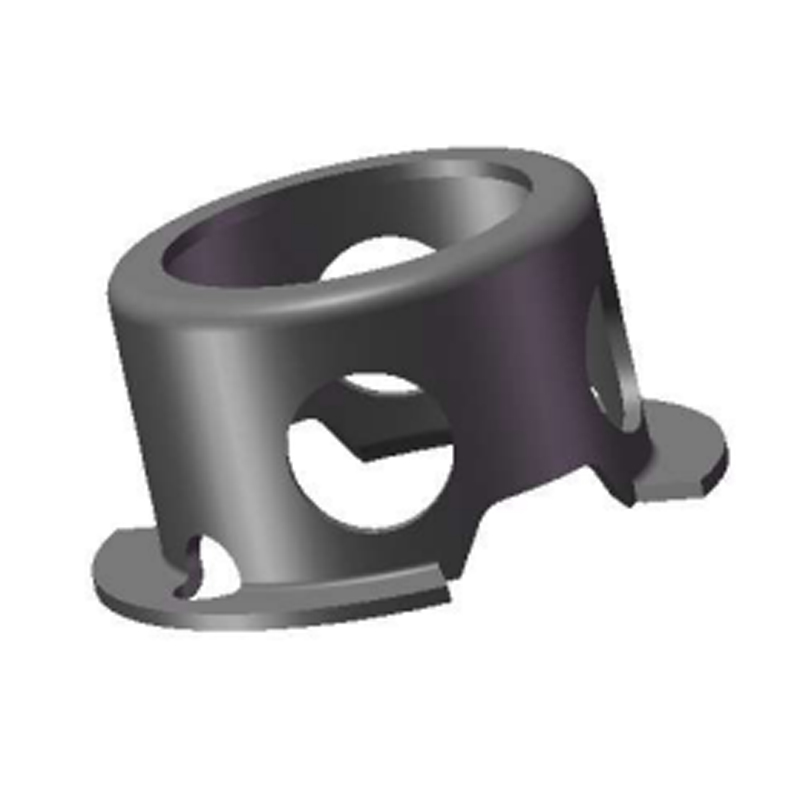
What separates non-standard stamping parts from commodity components is the range of complex geometries and specialized features they can incorporate. These are not simply flat blanks with a few holes — they are precision-engineered shapes with multiple functional characteristics built into a single formed part. Common specialized features include:
- Complex geometries: Multi-axis bends, deep draws, flanges at compound angles, and embossed ribs that add stiffness without adding material thickness. These geometries are designed in 3D CAD and translated into multi-stage die sequences.
- Unique cutouts: Asymmetric apertures, elongated slots with precise positional tolerances, and perforated patterns that serve both structural and functional purposes such as ventilation or wire routing.
- Reinforced sections: Locally thickened zones created through coining or ironing operations, which increase load-bearing capacity in specific areas without adding bulk to the whole part.
- Integrated mounting points: Extruded holes, clinch nuts, pressed-in studs, or formed bosses that eliminate the need for secondary fastening hardware and reduce assembly time in the final product.
- Surface treatments integrated into the workflow: Zinc plating, anodizing, or passivation applied immediately after stamping to protect the part before it enters the customer's assembly line.
The ability to combine multiple features into a single stamped part — rather than fabricating them separately and welding or fastening them together — is one of the core economic and performance advantages of the non-standard stamping approach. Fewer components mean fewer assembly steps, fewer potential failure points, and tighter overall dimensional control of the finished assembly.
How to Source Non-Standard Stamping Parts Effectively
Sourcing non-standard stamping parts requires a more involved supplier evaluation process than purchasing standard hardware. Because the entire production chain — from die design through first-article inspection — is built around your specific drawings, the supplier's engineering capability matters as much as their press capacity. The following criteria should guide supplier selection:
- In-house tooling capability: Suppliers who design and manufacture their own dies can respond faster to design changes and maintain tighter control over tooling quality. Outsourced tooling adds lead time and communication risk.
- Material handling range: Confirm that the supplier has experience with your specific material grade. Stamping stainless steel 316 requires different lubrication, press settings, and die coatings than stamping mild steel.
- Quality certifications: ISO 9001 certification is a baseline requirement. For automotive non-standard stamping parts, IATF 16949 certification indicates the supplier operates within the automotive quality management framework, including PPAP (Production Part Approval Process) documentation.
- First-article inspection reports: A reputable supplier should provide a full dimensional report for the first production batch, confirming that every specified feature meets drawing requirements before mass production proceeds.
- Prototype and low-volume flexibility: For new product development, the ability to produce small prototype runs using soft tooling or laser-cut samples before committing to hard die investment reduces financial risk significantly.
The production of non-standard stamping parts offers significant flexibility and customization for manufacturers, but realizing that potential depends entirely on choosing a supplier with the right combination of engineering depth, equipment range, and quality discipline. Clear communication of requirements at the RFQ stage — including tolerances, surface finish, material certifications, and assembly context — sets the foundation for a successful partnership and parts that perform optimally within their intended application from the very first delivery.