English
 中文简体
中文简体
Snap rings prevent axial displacement without adding significant weight or complexity to an assembly. They require no threading, no drilling, no welding — just a machined groove and the right ring. But specifying the wrong type between an internal snap ring and an external snap ring leads to installation failures, component drift, and costly rework. Here is exactly what separates the two and how to choose between them.
Content
- 1 What Are Internal and External Snap Rings?
- 2 Key Structural Differences at a Glance
- 3 Common Standards: DIN 471, DIN 472, and What They Mean for Sourcing
- 4 Material Options and Surface Finishes
- 5 How to Choose: A Practical Decision Framework
- 6 Typical Applications by Industry
- 7 Installation Basics and Tooling
What Are Internal and External Snap Rings?
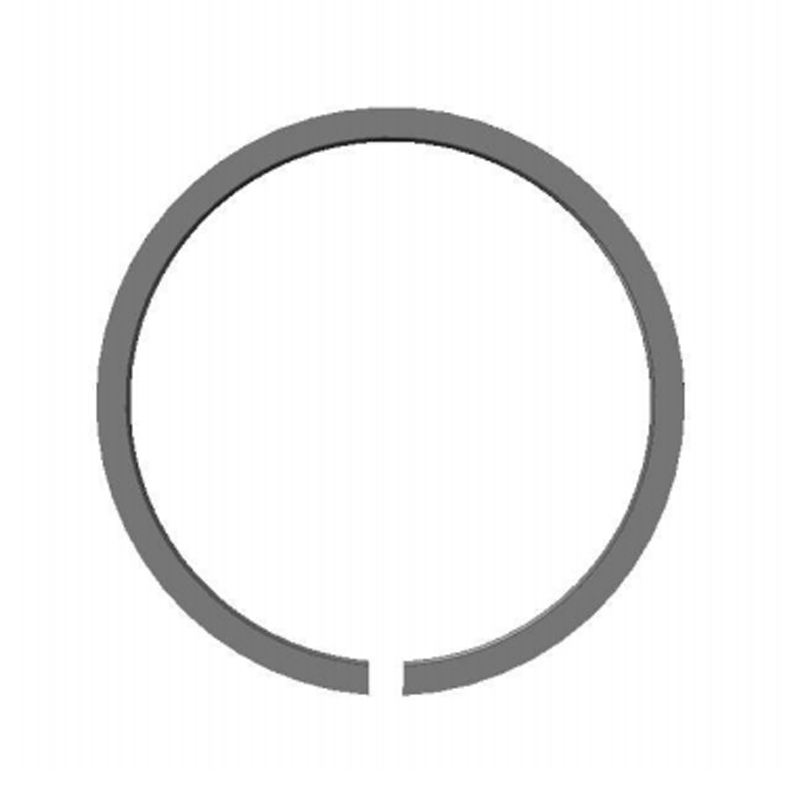
A snap ring — also called a retaining ring or circlip — is a stamped or coiled spring steel component that seats in a machined groove, forming a shoulder that holds adjacent parts in place along an axis. The distinction between internal and external types comes down to where that groove is located.
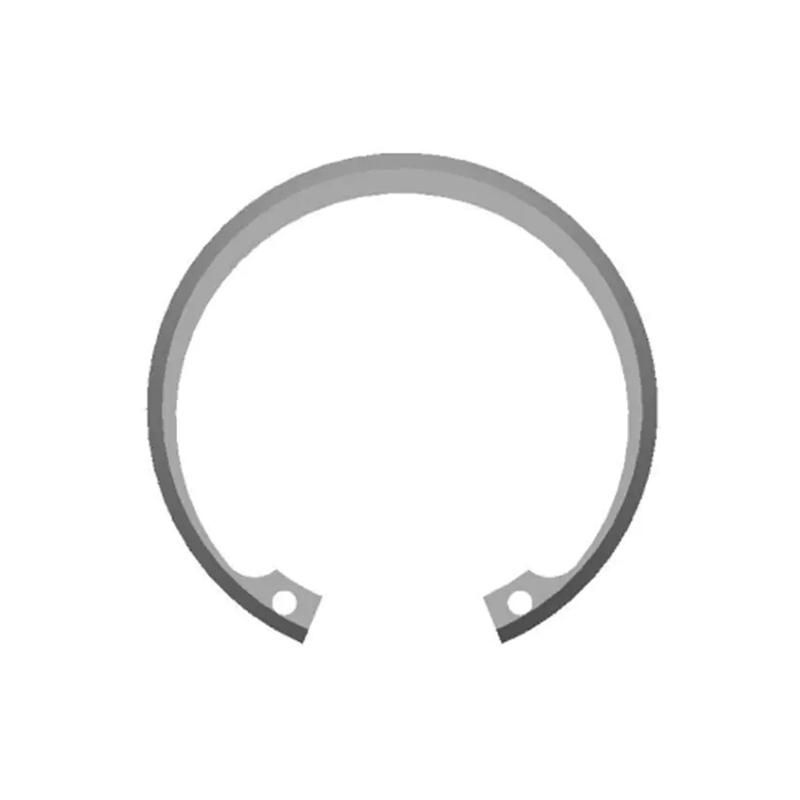
An internal snap ring for bore retention installs inside a cylindrical housing or bore. The ring is compressed during installation and springs outward to lock into the housing groove, creating a shoulder that prevents components from migrating inward or falling out of the bore. Think of wheel bearing housings, hydraulic cylinders, and gearbox bores.
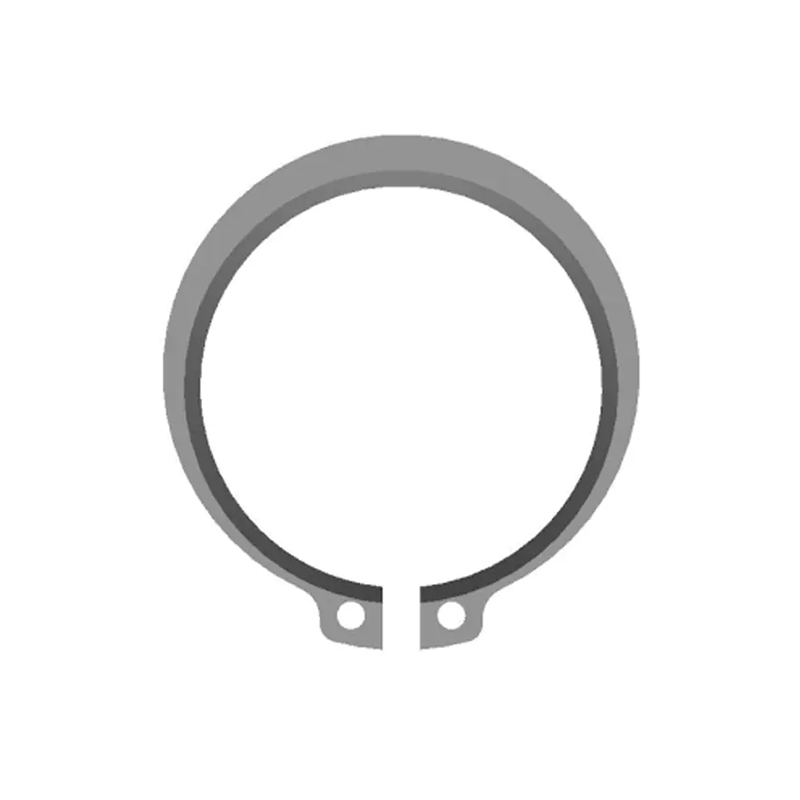
An external snap ring for securing shaft-mounted components wraps around the outside of a shaft. It is expanded during installation and contracts into the shaft groove, keeping bearings, gears, pulleys, and other parts from sliding off axially. Wherever a shaft carries rotating or sliding components, an external ring is typically what holds the assembly together.
Both types are also known as circlips, C-clips, or simply retaining rings depending on the industry and region. The terminology varies; the mechanical function does not.
Key Structural Differences at a Glance
The two types look similar at first glance — both are open-ended rings with small lug holes at each end — but their geometry, installation behavior, and force direction differ meaningfully.
| Feature | Internal Snap Ring | External Snap Ring |
|---|---|---|
| Installation location | Inside a bore or housing groove | Outside a shaft groove |
| Force direction during install | Compressed inward, springs outward | Expanded outward, contracts inward |
| Retained force direction | Resists inward/outward axial push from components | Resists outward axial push from components |
| Plier action required | Tips close (compress ring) | Tips open (expand ring) |
| Ring free diameter | Slightly larger than bore diameter | Slightly smaller than shaft diameter |
| Groove location | Inner wall of bore | Outer surface of shaft |
One practical note: external rings generally have a lower profile and sit more compactly around a shaft, which can be advantageous when radial space is limited. Internal rings, by contrast, must fit within the bore wall without compromising structural integrity, so bore wall thickness becomes a design constraint.
Common Standards: DIN 471, DIN 472, and What They Mean for Sourcing
Most industrial snap rings are manufactured to one of the major international standards. Knowing the standard number is the fastest way to ensure groove compatibility and interchangeability across suppliers.
DIN 471 covers external snap rings for shafts. It defines groove dimensions, ring thickness, and load ratings for metric shaft diameters, typically ranging from 3 mm to 300 mm. DIN 472 is the counterpart for internal rings in bores, with housing diameters from 8 mm to 600 mm. Detailed dimensional data for DIN 472 bore retaining ring specifications including groove depth, width, and chamfer requirements is publicly available for engineering reference.
| Standard | Type | Typical Size Range | Common Application |
|---|---|---|---|
| DIN 471 | External (shaft) | 3–300 mm | Gearboxes, axles, motor shafts |
| DIN 472 | Internal (bore) | 8–600 mm | Bearing housings, hydraulic cylinders |
| DIN 983 | External with lugs | 3–100 mm | High-load shaft applications |
| DIN 984 | Internal with internal tooth | 8–150 mm | Anti-rotation bore retention |
| DIN 6799 | E-clip (external radial) | 2–24 mm | Side-loaded, limited axial access |
For metric applications, the DIN 472 metric internal circlip series and the DIN 471 external circlips for metric shafts are the most widely specified. If your application uses inch-based dimensions, look for ASME/ANSI-compliant equivalents or confirm interchangeability with the supplier before ordering.
Material Options and Surface Finishes
The base material determines how a snap ring performs under load, temperature extremes, and environmental exposure. Most industrial applications are covered by three core materials.
Carbon spring steel (typically C60S or C75S per DIN 17222) is the standard choice for general-purpose use. It offers excellent spring-back characteristics, high hardness after heat treatment (HRC 44–54 depending on diameter), and cost efficiency at volume. The limitation is corrosion resistance — without a surface treatment, carbon steel rings will oxidize in humid or wet environments.
Stainless steel options include martensitic grades (1.4122 / X39CrMo17) for applications needing both hardness and moderate corrosion resistance, and austenitic grades (AISI 301, AISI 316L) for food processing, marine, and pharmaceutical environments where chemical exposure is a factor. Austenitic stainless trades some hardness for significantly better corrosion resistance.
Surface treatments on carbon steel rings extend service life considerably. Phosphate-and-oil (P&O) is the most common — it provides mild corrosion protection, reduces friction during installation, and is the default finish on most DIN 471 and DIN 472 stock rings. Zinc plating and black oxide are available for more demanding environments.
For non-standard materials or specialized coatings, custom stamped options can be manufactured to specific requirements — including proprietary alloys for high-temperature or chemically aggressive settings.
How to Choose: A Practical Decision Framework
The selection process is straightforward once you work through a few concrete questions.
Where does retention happen? If the component sits inside a housing and must be retained from exiting the bore, use an internal snap ring. If the component mounts on a shaft and must be held from sliding off axially, use an external ring. This single question resolves the majority of cases.
What are the groove dimensions? Snap rings are groove-specific. Measure the housing bore diameter (for internal) or shaft diameter (for external), then verify the groove width and groove depth against the ring manufacturer's specification sheet. A ring seated in an undersized groove will not provide full thrust capacity; in an oversized groove, it may pop out under load.
What axial loads will the ring face? Standard stamped rings handle moderate thrust loads adequately. For shock loads, vibration, or high RPM applications, consider rings with a larger cross-section or multiple-turn spiral designs. The snap ring product catalog includes both standard and heavy-duty anti-shift options for demanding conditions.
What is the operating environment? High humidity, saltwater exposure, and chemical contact all point toward stainless steel. Standard carbon steel with phosphate finish works well in dry, moderate-temperature industrial environments.
How often will the ring be removed? Snap rings can be reused, but repeated installation and removal causes work hardening and dimensional change. For assemblies that require frequent disassembly, budget for ring replacement and ensure the groove remains undamaged between cycles.
Typical Applications by Industry
Internal and external snap rings appear across virtually every sector of manufacturing and mechanical engineering. A few representative applications illustrate how differently the two types serve in practice.
In automotive drivetrains, external rings seat on transmission output shafts to retain planetary gear sets, while internal rings hold bearing cups inside differential housings. Both types often coexist within the same assembly — distinguished only by whether the groove faces inward or outward.
In electric vehicle motors, snap rings handle retention of stator bearings and resolver housings under high rotational speeds. The low mass and zero-clearance profile of a properly seated ring make it preferable to threaded fasteners in high-RPM environments where dynamic balance matters.
In agricultural machinery, both ring types are found in hydraulic cylinder assemblies (internal) and PTO shaft systems (external), where they must withstand vibration, contaminated environments, and field service conditions that demand corrosion-resistant materials.
In industrial automation and robotics, miniature snap rings in the 8–25 mm range retain precision bearings in actuator housings, where positional accuracy depends on the ring maintaining a true shoulder without deflection under cyclic loads.
Installation Basics and Tooling
Correct installation is as important as correct specification. A properly chosen snap ring installed carelessly — over-expanded, cross-seated, or incompletely engaged in the groove — provides none of its rated retention capacity.
Both internal and external rings require dedicated snap ring pliers that engage the lug holes and apply controlled, even force. For internal rings, the plier tips compress the ring; for external rings, the tips expand it. Using the wrong plier type, or substituting general-purpose pliers, risks deforming the ring or damaging the groove chamfer.
After seating, confirm visually and by feel that the ring is fully seated around the entire groove circumference. A ring that spans the groove at only three or four points has not fully engaged and will fail under axial load. For applications with restricted access or production assembly volumes, custom-geometry retaining rings and nonstandard stamped components can simplify installation tooling and reduce assembly time.