English
 中文简体
中文简体
Every production engineer has seen the same failure pattern: a retaining ring that loses its grip during a high-vibration run, or a spring washer that slowly gives up its clamp load after repeated thermal cycling. The symptoms look different, but the root cause is often identical — the steel never received the precipitation heat treatment needed to develop its full elastic strength.
Precipitation heat treatment — also called precipitation hardening or age hardening — is a three-stage thermal process that raises the yield strength, hardness, and fatigue resistance of selected alloys. For circlips, spring washers, and stamped fasteners, it is the difference between a component that stays locked in its groove and one that creeps out under load.
Key takeaway: Correctly applied precipitation heat treatment can raise yield strength by 50% or more compared with the annealed state, while causing minimal distortion — which is why thin, tight-tolerance parts such as circlips and Belleville washers depend on it.
Content
- 1 What Precipitation Heat Treatment Actually Does
- 2 The Three Stages of Precipitation Heat Treatment
- 3 How It Compares: Precipitation Hardening vs. Other Routes
- 4 Aging Response: The Hidden Peak
- 5 Where Precipitation-Hardened Parts Matter Most
- 6 Specifying Precipitation-Hardened Fasteners: A Practical Guide
- 7 Maintenance, Inspection, and Compliance
What Precipitation Heat Treatment Actually Does
The mechanism is not about making metal stronger through cold work or martensite transformation. Instead, the alloy is forced to release extremely fine precipitates inside its crystal structure. Those particles block the movement of dislocations — the microscopic defects that allow metal to bend and yield. More obstacles mean higher strength.
For a fastener component, this delivers three measurable benefits:
- Higher elastic limit — the part springs back to its original shape after repeated deflection, which is exactly what a circlip must do every time it is spread and installed.
- Stable clamp load — resistance to stress relaxation keeps spring washers tight at working temperatures up to roughly 300°C, depending on grade.
- Longer fatigue life — fine, uniformly dispersed precipitates delay crack initiation under cyclic vibration.
Yield strength increase over the annealed condition in common age-hardening alloys.
Approximate working limit for age-hardened spring steel before stress relaxation accelerates.
Aging produces minimal dimensional change, preserving the groove-fit tolerances of precision stampings.
The Three Stages of Precipitation Heat Treatment
Stage 1 — Solution Treatment
The part is heated into a temperature range where all alloying elements dissolve into a single solid solution. For carbon spring strip this is typically 780–880°C; for precipitation-hardening stainless steel, up to about 1065°C; for aluminum alloys, 470–500°C. The hold time must be long enough to homogenize the structure but short enough to avoid grain growth. For stamped components, this stage also relaxes the internal stress introduced by blanking and forming.
Stage 2 — Quenching
Rapid cooling traps those dissolved elements in place, creating a supersaturated solid solution. At this point the metal is harder than annealed but nowhere near its final strength. Quench media range from water and oil to polymer solutions or forced air. Thin sections like circlips and washers cool quickly, yet the quench still has to be regulated to avoid distortion or cracking.
Stage 3 — Aging
Controlled reheating at a lower temperature — typically between 150°C and 500°C depending on the alloy — allows the dissolved elements to nucleate and grow as ultra-fine precipitates. Under-aging leaves strength undeveloped; over-aging coarsens the particles and softens the material. Precision time-temperature control is what separates a reliable heat treater from a guesser.
How It Compares: Precipitation Hardening vs. Other Routes
Heat treatment selection is an engineering decision that depends on the product's shape, thickness, and loading. The comparison below summarizes the most common routes a fastener manufacturer can apply.
Aging Response: The Hidden Peak
Every age-hardening alloy has a hardness peak, and the only way to find it is to sample parts across time and temperature. The chart below shows a typical aging response for a spring steel strip held at 350°C after quenching. Hardness rises as fine precipitates form, then declines as particles coarsen.
This is the hidden indicator most buyers never ask about. Under-aged material may pass a minimum hardness test yet still lack the full elastic limit designed into the product. Over-aged material risks early fatigue failure. A responsible supplier tracks the curve for each batch and documents the actual aging window.
Where Precipitation-Hardened Parts Matter Most
The industries that demand the most from fasteners are the same ones driving precipitation heat treatment specifications. The distribution below represents typical consumption of age-hardened spring steel components across industrial sectors.
In automotive transmissions and CV joints, DIN 471 external circlips for shafts must maintain radial grip through millions of high-RPM load cycles. In wind turbines, gearbox housings need bore-side retention that tolerates both vibration and lubricant temperature. In construction machinery, spring washers must hold preload for decades without scheduled retightening.
 DIN 471 External Circlips for Shaft RetentionThese external circlips prevent axial displacement on shafts, with materials like 65Mn and stainless steel and surface treatments such as phosphating and zinc plating. They suit high-RPM automotive and wind turbine applications where radial grip and vibration resistance are critical.View Product →
Specifying Precipitation-Hardened Fasteners: A Practical Guide
Buyers and design engineers tend to focus on price and lead time, but the specification of heat treatment is what determines service life. Work through the following five steps, and you will have a procurement spec that survives contact with reality.
Define service conditions
Record the operating temperature range, load cycle, and vibration level. These three inputs decide whether carbon spring steel, 50CrV4, or a precipitation-hardening stainless grade is appropriate.
Select material and standard
Match the grade to the applicable standard — DIN 471 and DIN 472 for circlips, DIN 2093 for Belleville washers, DIN 988 for flat washers. Standards define hardness ranges, dimensions, and test methods.
Set acceptance criteria
Agree on the hardness window, proof load, and surface condition. For a circlip, groove-fit tolerance and full deflection without permanent set are non-negotiable.
Verify process control
Ask how the manufacturer controls the aging curve for every batch. Full in-house production — from rolling and stamping through heat treatment to optical sorting — shortens the feedback loop and improves consistency.
Demand documentation
Request material certificates, hardness test reports, and dimensional inspection records. Independent accreditation of the supplier's test center adds real confidence.
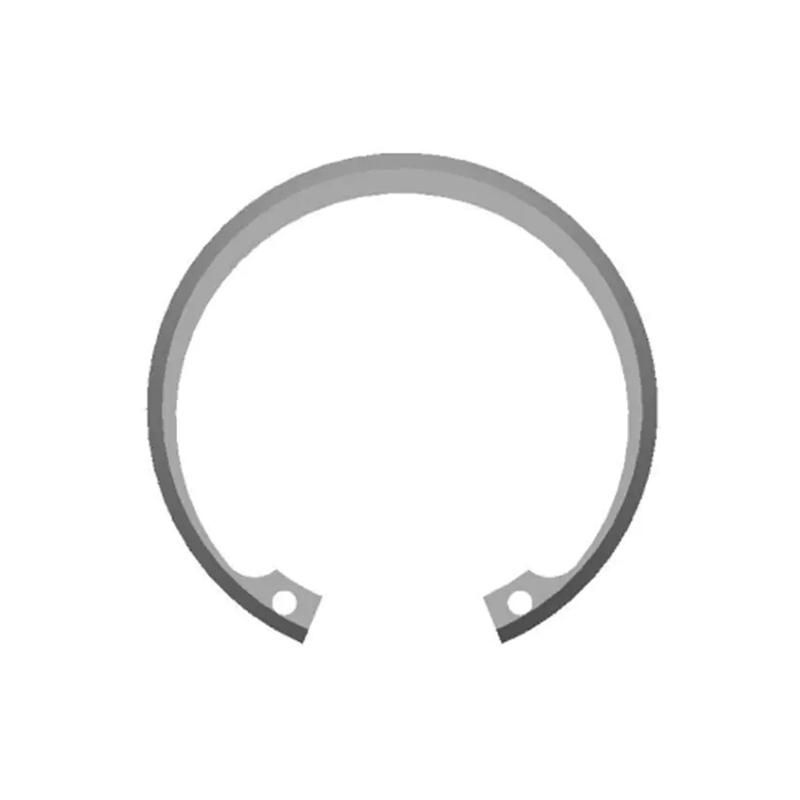
When the application is a hub or housing bore, DIN 472 internal circlips remain the standard answer for retaining bearings and components where disassembly access is limited.
 DIN 472 Internal Circlips for Bore RetentionDesigned for installation in internal grooves, these metric circlips limit axial movement of components in bores. Available in carbon and stainless steels with standard surface treatments, they are ideal for bearing retention where disassembly access is limited.View Product →
For designs that need a high, predictable preload in a tight envelope, DIN 2093 high-load Belleville spring washers deliver a progressive spring rate — but only if the strip has been aged to its verified hardness peak.
 DIN 2093 High-Load Belleville Spring WashersThese conical disc springs provide a progressive spring rate and maintain preload in tight envelopes. Made from spring steels like 51CrV4, they offer low stroke with high compensation force, preventing loosening and absorbing shock in mechanical and electronic equipment.View Product →
Maintenance, Inspection, and Compliance
Heat treatment decisions do not end at the factory gate. How a component is stored, installed, plated, and inspected determines whether the metallurgical advantage survives.
- Never reuse circlips or retaining rings. A ring that has been spread for removal has already been stressed beyond its elastic limit; reinstalling it invites fatigue failure.
- Bake after plating. Hydrogen introduced during electroplating can cause delayed fracture in high-hardness steel. A post-plate bake at 190–220°C for at least four hours is standard practice.
- Check hardness on incoming inspection. A portable hardness test on a sample batch catches under-aging and over-aging before parts reach the line.
- Confirm traceability. The interaction between heat treatment and surface coating decisions can shift corrosion resistance and fatigue behavior in ways that batch certificates should document.
Compliance expectations are also tightening. Buyers increasingly request material declarations that confirm REACH and RoHS alignment, plus test reports from accredited laboratories. A CNAS-accredited in-house testing center reduces the documentation burden and shortens approval cycles for new suppliers.
Precipitation heat treatment is not a mysterious metallurgical ritual; it is a measurable, controllable process. The real difference between a premium retaining ring and a premature failure is whether that process was specified, monitored, and verified. Before you approve a fastener supplier, ask how they age-harden their material, which hardness window they guarantee, and how they prove it. The answers will tell you more than the price per thousand.